Why Most Funnels Fail: Chasing the 9%, Missing the 60%
- visiognrove
- Jul 15, 2025
- 5 min read

You've built a funnel. You're running ads. You've got all the pieces in place—but something's not working. The conversions aren't happening, and you're wondering why your marketing funnel is failing when you've followed all the "expert" advice.
Here's the uncomfortable truth: most marketing funnels fail because they're designed to serve the wrong audience. They focus exclusively on the small percentage of people ready to buy right now—while completely ignoring the much larger group who represent your actual future revenue.
The Buyers Pyramid: The Reality Nobody Talks About
When we analyze how real people make buying decisions, we discover a critical distribution that changes everything about how marketing should work:
9% of your audience is ready to buy right now
60% are watching, waiting, and considering (but not ready yet)
30% are either not interested or not a good fit

This isn't just a theory—it's the reality of how markets actually work. Yet most marketing funnels are designed exclusively for the 9%, treating everyone else as "cold leads" or, worse, completely ignoring them.
The traditional funnel model assumes that people enter at the top and flow neatly downward toward purchase. But that's not how real humans make decisions. Real people circle around, gather information, leave, come back, and make decisions on their own timeline—not yours.
Why Chasing Only the 9% Is a Recipe for Failure
When you build your marketing system to serve only those who are ready to buy immediately, you create three massive problems:
1. You're Fighting for the Smallest Slice of the Market
The 9% who are ready to buy now are also being actively pursued by every competitor in your space. These are the people searching for "buy [your product] now" or "best [service] pricing." Every business is competing for their attention, making this the most expensive and competitive part of the market.
In essence, you're spending the most money to reach the smallest group with the highest competition. From a business perspective, that's a formula for thin margins and constant pressure.
2. You're Ignoring Your Actual Revenue Engine
The 60% who are interested but not ready to buy represent your actual growth potential. These are people who:
Have the problem you solve
Are aware they have the problem
Are actively seeking information about solutions
Haven't made a final decision yet
This group will become your future customers—but only if you nurture them with value first, rather than pushing for immediate conversion.
3. You Create a Feast-or-Famine Business Cycle
When your marketing focuses exclusively on immediate conversion, you create a system that's inherently unstable. When market conditions change or competition increases, your pipeline dries up because you have no relationships with potential future customers.
This leaves you constantly scrambling for the next customer rather than building a sustainable business with predictable revenue.
The A.I.D. Framework: Building Funnels That Actually Work
At VisionGrove Creative, we've developed an alternative to the traditional funnel model. We call it the A.I.D. Framework—Attract, Intrigue, Deliver. Unlike traditional funnels, this approach focuses on building relationships with the full spectrum of potential customers, especially the critical 60%.
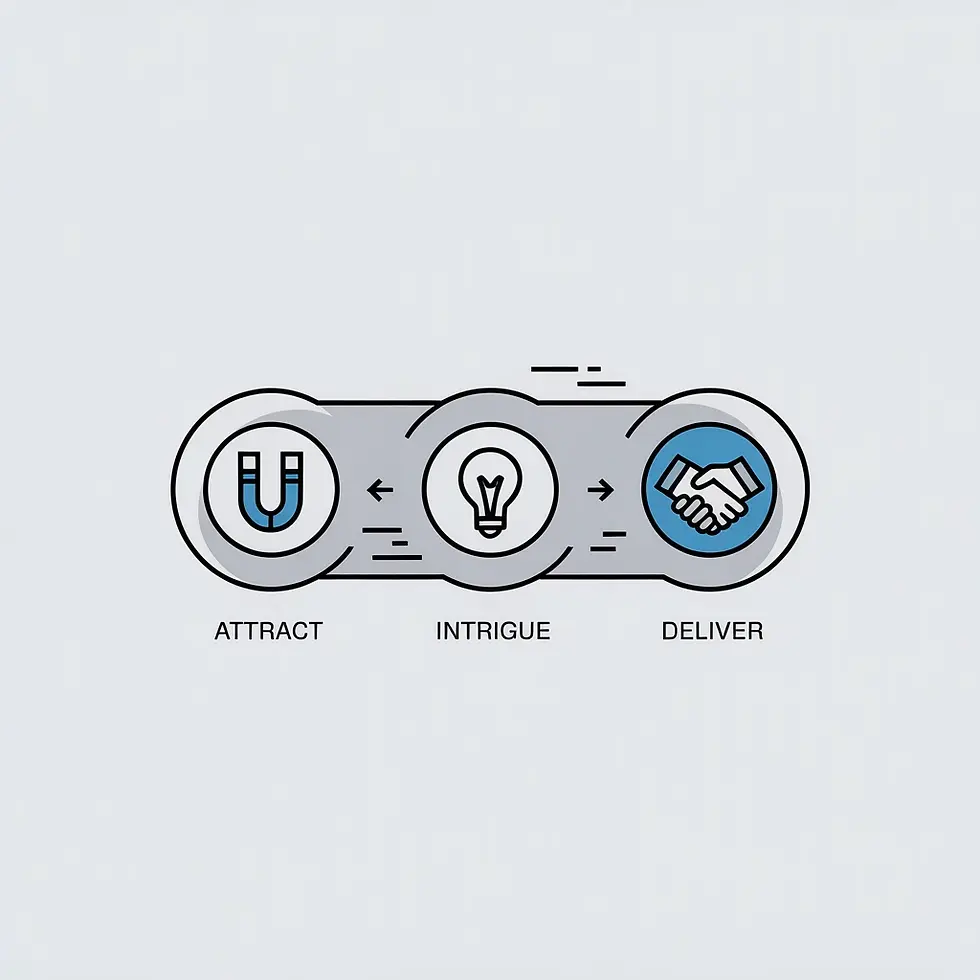
Attract: Value Before Revenue
Instead of starting with sales pitches, effective marketing begins by attracting the right people with genuine value. This means creating content, resources, and tools that help people solve real problems—whether they buy from you or not.
For example:
Educational content that answers real questions
Free tools that solve actual problems
Resources that help people make better decisions
The goal isn't immediate conversion—it's establishing trust by demonstrating that you understand their problems and can help solve them.
Intrigue: Earn Attention Through Relevance
Once you've attracted people with value, you need to intrigue them with possibilities. This means showing them specifically how your approach can help them solve their particular problems.
This stage is about relevance and possibility, not pressure. You're helping people see that:
You understand their specific situation
You have a proven approach to solving it
Others like them have succeeded with your help
Deliver: Make Good on Your Promises
The final stage is where you actually deliver on the promises you've made through your marketing. This is where the 9% who are ready to buy enter your world—but they do so with confidence because you've already demonstrated value and built trust.
The key difference? These customers come to you pre-qualified, pre-educated, and ready to engage. They're not being pressured or manipulated—they're making an informed choice to work with you.
How to Fix Your Failing Funnel
If your current marketing funnel isn't performing, here's how to transform it using the principles from our Marketing Manifesto:
1. Segment Your Audience Honestly
Stop pretending everyone is ready to buy right now. Instead, create separate tracks for:
The 9% who are ready to purchase (direct response)
The 60% who need nurturing (relationship building)
The 30% who aren't a fit (polite disqualification)
2. Build Relationship Assets, Not Just Sales Assets
Most marketing focuses exclusively on sales assets—landing pages, sales emails, checkout processes. These serve the 9% but do nothing for the 60%.
Relationship assets include:
Educational content that teaches, not just sells
Email sequences that provide ongoing value
Communities where people can connect and learn
Tools and resources that help solve real problems
3. Measure Relationship Metrics, Not Just Sales Metrics
If you only measure conversion rates and sales, you'll optimize for the 9% and ignore the 60%. Instead, track:
Email engagement rates
Content consumption
Return visits
Time to conversion
These metrics show you how effectively you're building relationships with the 60%—your actual future revenue.

4. Build Trust First, Ask for the Sale Second
The single biggest mindset shift is putting relationship before revenue. This means:
Providing value before asking for anything in return
Educating, not just persuading
Helping people make good decisions, even if that sometimes means not buying from you
This approach feels counterintuitive in a world of aggressive marketing, but it's how you build a sustainable business with loyal customers.
The Long Game Wins Every Time
Marketing that focuses exclusively on immediate conversion is playing a short game that's increasingly difficult to win. As ad costs rise and consumer skepticism grows, the businesses that thrive will be those that build genuine relationships with their entire audience—especially the 60% who represent future growth.
The companies that master this approach enjoy:
Lower customer acquisition costs
Higher lifetime customer value
More referrals and word-of-mouth
More stable, predictable revenue
Less vulnerability to market fluctuations
Stop Chasing, Start Nurturing
If your marketing funnel is failing, it's likely because you're chasing the 9% and ignoring the 60%. The solution isn't a better sales pitch or a more aggressive call to action—it's a fundamental shift in how you think about marketing.
When you build marketing systems that provide genuine value to your entire audience—especially those who aren't ready to buy right now—you create the foundation for sustainable growth and lasting success.
Ready to transform your approach to marketing? Download our free Marketing Manifesto at VisionGrove Creative and discover how to build marketing that makes sense before it makes dollars.
Comments